Premium cataract care, recommended by the optician you already trust
Your local optician at Optika has noticed the early signs of cataracts and taken the time to refer you to a specialist team they trust. At Vision Care Clinic Bristol, we take it from here — with a personal, detailed assessment, plain-English explanations, and a care plan built around how you live your life.
- Trusted handover between local eye care teams
- Detailed planning before any treatment decision
- Clear plan for fine-tuning if needed after surgery
- An option to have both eyes treated on the same day
Clearer sight
Patients often notice a meaningful improvement in clarity and quality of vision after cataract treatment.
Day-case care
Treatment is usually performed as a day case, so you normally go home the same day.
Lifestyle lens choices
We discuss lens options shaped by your daily activities, not a one-size-fits-all approach.
Thoughtful follow-up
We stay involved after treatment, including a clear plan if any prescription fine-tuning is needed.
What a cataract is, in everyday terms
The natural lens inside your eye is usually clear. Over time, often as a natural part of getting older, that lens can become cloudy. This is a cataract. It is not a growth on the eye or something you have caught; it is a change in the material of your own lens. The good news is that it is one of the most treatable conditions in modern eye care.
Sight that feels hazy or slightly washed out. Glare or haloes around lights, particularly when driving at night. Colours that seem less vivid. Difficulty reading in low light. These changes often develop slowly, and many people initially put them down to needing a stronger glasses prescription.
Cataract surgery gently removes the cloudy natural lens through a small incision and replaces it with a clear artificial lens. The procedure is usually performed under local anaesthetic, with recovery guided by your clinical team.
The replacement lens is not a neutral swap; it offers an opportunity to address your prescription at the same time. The lens you choose can influence how much you rely on glasses after surgery and which visual tasks feel most natural. This is an excellent opportunity to align your outcome with your individual vision and lifestyle requirements.
The Normal Eye
Clear natural lens
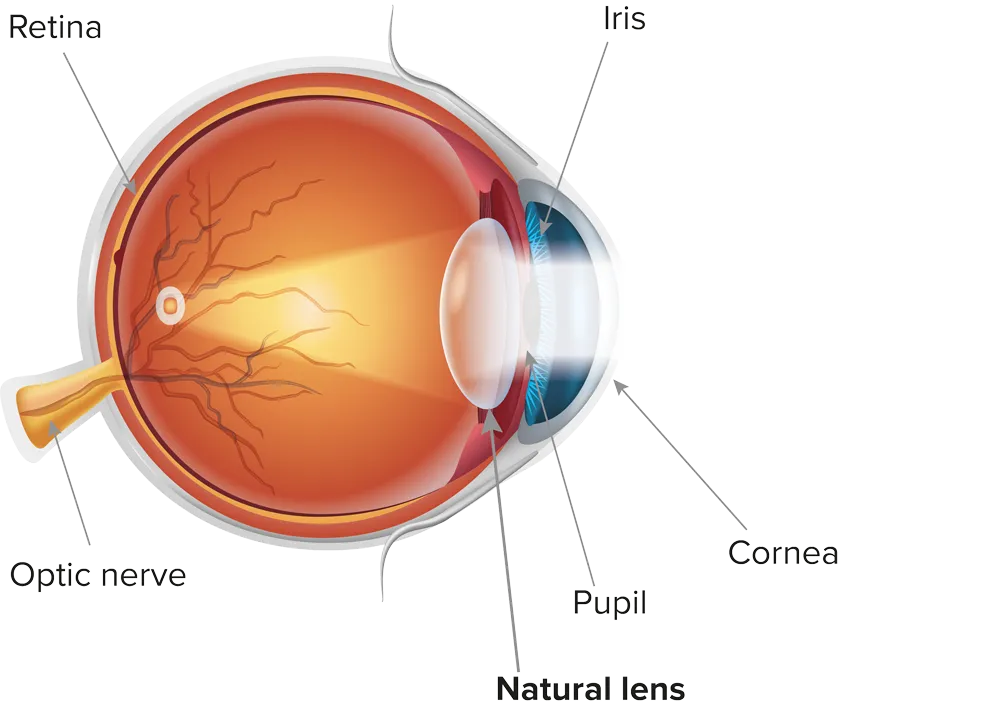
The natural lens focuses light within the eye. By changing shape it helps you see into the distance and read up close.
Cataract
Cloudy natural lens
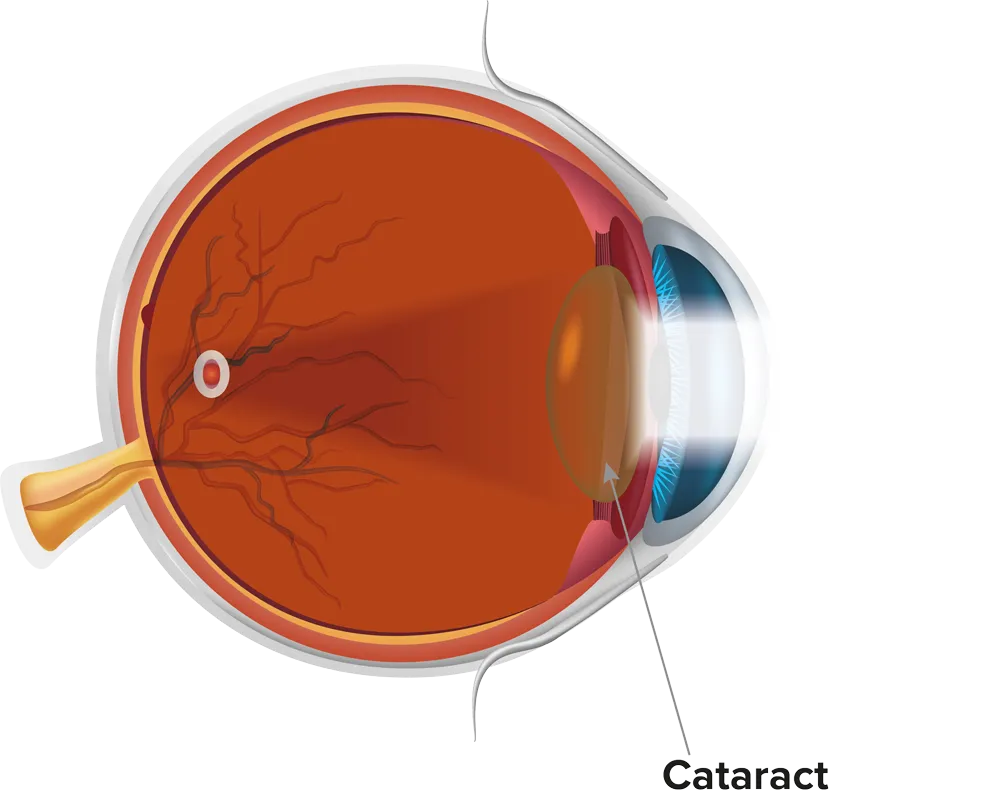
A cataract is the clouding of the natural lens. This causes blurring and reduces the focus range.
Post-Surgery
Artificial lens
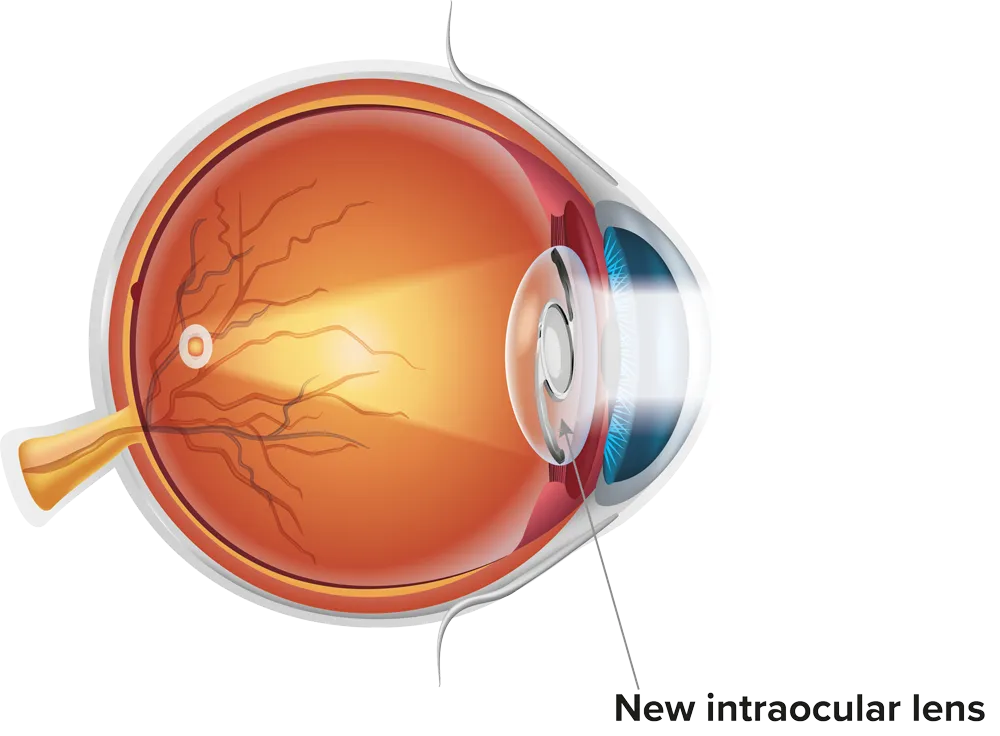
During cataract surgery, the natural lens is replaced with a permanent artificial lens, typically made from acrylic (plastic). This new lens cannot change shape like your previous clear natural lens. It is therefore vital to match the type of lens inserted to your lifestyle and needs.
What happens from referral to clearer sight
Referral received
We receive your optician's referral and our team makes contact to arrange your initial assessment at a time that suits you.
Detailed assessment
Your assessment is thorough and unhurried. We carry out detailed measurements of your eye, review your prescription history, and spend time understanding how you live and what you want from your vision.
Lens decision
Based on your assessment and a full discussion of your preferences, we recommend a lens option and explain the likely outcomes clearly. Following the consultation, you receive a detailed summary, including the rationale for the recommendation. You decide when you are ready; there is no pressure.
Day-case treatment
Treatment takes place as a day case at the clinic. You go home the same day, with clear guidance on drops, recovery, and what to expect next.
Follow-up and fine-tuning
We follow up at scheduled intervals to check how your eye is settling. If your result can be improved with laser enhancement, we discuss the options clearly. Your referring optician is kept informed throughout.
A confident handover from one eye care team to another
A referral from Optika is not just a letter — it is a sign that two eye care professionals are working together on your behalf. Your optician knows your history, has followed any changes over time, and has made a considered decision that the moment is right for you to see a specialist. We honour that trust by making sure the next step feels just as thoughtful as the one that got you here.
- Your notes from Optika and recent observations can help our assessment team understand what has prompted the referral.
- We carry on where your optician left off, so the experience feels joined up rather than fragmented.
- You will speak to a clinical team who have time to listen and explain, not just run through a checklist.
- We keep your local eye care team informed at significant stages, so they remain part of your care after treatment.
Why a small prescription surprise can still happen
Even with advanced scanning and measurement technology, cataract surgery involves a degree of biological variability that cannot be entirely predicted. The calculations used to select your replacement lens are highly accurate, but they are calculations rather than guarantees.
After surgery, the lens settles into its final position as the eye heals. Everyone heals slightly differently, and the final resting position of the lens cannot be predicted with complete precision in every case. On occasion, this means the eye settles at a slightly different prescription than planned. This is often called a refractive surprise, and while the phrase can sound alarming, it is a known and manageable outcome.
Laser enhancement is a precision procedure that aims to gently correct any remaining prescription after the eye has fully healed. Offering it as part of your aftercare pathway is not a sign that anything has gone wrong; it is a responsible approach to ensuring that if your result can be refined further, there is a clear route to discuss it. We care about your vision and the outcome as much as you do, which is why Vision Care Clinic offers laser enhancement where clinically appropriate.
"A premium cataract pathway is not about promising perfection. It is about careful preparation, detailed assessment, and creating a considered treatment plan that is tailored to each patient, including how best to manage any unexpected findings or challenges that may arise."
Three lens routes, explained by lifestyle benefit
There is no single correct lens for every patient. The right choice depends on your prescription, your daily life, and what matters most to you. During your assessment, we will walk through the options in plain English.
Sharper distance
Who it may suit: Patients who are most active outdoors, who drive regularly, or who find distance vision the priority.
Daily-life benefit: Clear, dependable distance vision. Reading glasses would still be needed for close and computer-distance work.
Suitability depends on your individual assessment measurements.
More everyday range
Who it may suit: Patients who move between different distances through the day, such as working on a screen, looking across a room, or reading in good light.
Daily-life benefit: Greater visual flexibility and more spectacle independence for everyday tasks, while still accepting that reading glasses may be useful for some situations.
Suitability depends on your individual assessment measurements.
More glasses freedom
Who it may suit: Patients who want to reduce their day-to-day reliance on glasses across a range of activities.
Daily-life benefit: Extended range of clear vision across multiple distances. This does not guarantee complete glasses independence, but it aims to provide a high level of functional spectacle independence.
Suitability depends on your individual assessment measurements.
A premium pathway designed around getting the details right
Most cataract care is excellent. What distinguishes a premium pathway is not the basic procedure; it is the depth of preparation, the time spent on planning, and the breadth of aftercare available when it matters.
More extensive assessment
Our pre-operative assessment goes beyond a standard examination. We use precise measurements and multiple imaging devices to build an accurate picture of your eye before any decision is made.
Planning time that counts
Careful planning helps reduce the chance of avoidable surprises. We take time to review your measurements, discuss your lifestyle priorities, and select the lens most likely to support the result you are hoping for.
Lifestyle-led lens choice
We weigh your prescription, visual demands, hobbies, work, and preferences together, then explain our recommendation and the alternatives before you decide.
Joined-up local care
We work closely with your referring optician throughout. After treatment, we coordinate follow-up so there are no gaps between specialist care and the eye care team you already know.
Questions we hear most often
Most people are understandably a little anxious about whether cataract surgery will hurt. In practice, patients are often reassured by how comfortable and straightforward the experience feels. The procedure is carried out using local anaesthetic, usually in the form of numbing eye drops. You may notice bright lights, gentle movement, or a feeling of mild pressure, but significant pain is not expected. Afterwards, the eye can feel slightly gritty or watery for a short time, and this usually settles over the first few days.
Cataract surgery prices start at £3950 per eye. If you have astigmatism we use toric intraocular lenses to correct this as standard, with no additional fee. For further information please visit https://visioncareclinic.com/about/fees/. Financing options are available.
This will depend upon your working environment. Most people can return to work after 3-4 days but if you work in a dirty environment you may need up to two weeks off work.
This depends on the lens option chosen and on how your eye settles during healing. Patients who choose a distance-focused lens are comfortable without glasses for many activities wil need reading and computer glasses. Patients who choose a wider-range lens often rely on glasses less overall, though this is never guaranteed. We explain realistic outcomes for your individual situation during your assessment.
The operation itself typically takes 5-10 minutes per eye. Including check-in, dilating drops and recovery, plan on being at the clinic for 2–4 hours. It is a day-case procedure.
The lens calculation is only as good as the measurements it is based on. A thorough assessment helps us understand the shape and characteristics of your eye, check for any issues that could affect the outcome, and gather the information needed to recommend the most suitable lens. It is also the point where we learn about your lifestyle, priorities, and expectations, so the plan is tailored to you rather than generic.
Laser enhancement refers to a laser vision correction procedure performed after cataract surgery has fully healed. If your eye settles with a small remaining prescription, enhancement can sometimes refine the focus further. It is not expected in every case, but it provides a clear route to discuss fine-tuning if that would improve your result.
Most patients see clearer within 24–72 hours, with vision fully stabilising over 4–6 weeks.
Under DVLA rules, you can drive once you can read a number plate at 20 metres. Most patients achieve daytime driving proficiency within 24–48 hours and night driving within 2–4 weeks.
A More Thorough Approach to Your Cataract Care
See how a consultation at Vision Care Clinic compares to a standard private cataract assessment.
| Assessment & Care | Typical Private Provider | Vision Care Clinic Gold Standard |
|---|---|---|
| Consultation length | 15–30 minutes | Up to 90 minutes |
| Visual acuity testing | ✓ | ✓ |
| Basic eye assessment | ✓ | ✓ |
| Biometry (lens power calculation) | ✓ | ✓ |
| High-resolution Optical Coherence Tomography (OCT) | Sometimes | ✓ Standard |
| Corneal tomography | ✗ | ✓ |
| Aberrometry | ✗ | ✓ |
| Pupillometry | ✗ | ✓ |
| Ocular & corneal wavefront analysis | ✗ | ✓ |
| In-house excimer laser enhancements | ✗ Not offered | ✓ Included if needed* |
| Refractive fine-tuning after surgery | Referred externally | Performed in-house |
| Continuity of care | Multiple providers | One dedicated team |
Every patient at Vision Care Clinic receives the same gold-standard pathway — because taking the time to understand your needs combined with precise diagnostics lead to better visual outcomes. *Inclusive in our premium package, otherwise charges may apply.
Start with a detailed cataract assessment
We would be delighted to hear from you. Please complete the short form below and a member of our team will be in touch to arrange your assessment.
There is no obligation at this stage — simply an opportunity to discuss your vision, understand your goals, and explore which treatment options may be suitable for your eyes.
- ✓ No waiting list pressure
- ✓ We call at a time that suits you
- ✓ Your referring optician is notified